Edge0-120B model benchmark: speed and quality
Edge0 fit Qwen3.8-Flash-Next on one GPU. On a GB10 it writes twice as fast as the original, and codes about as well.
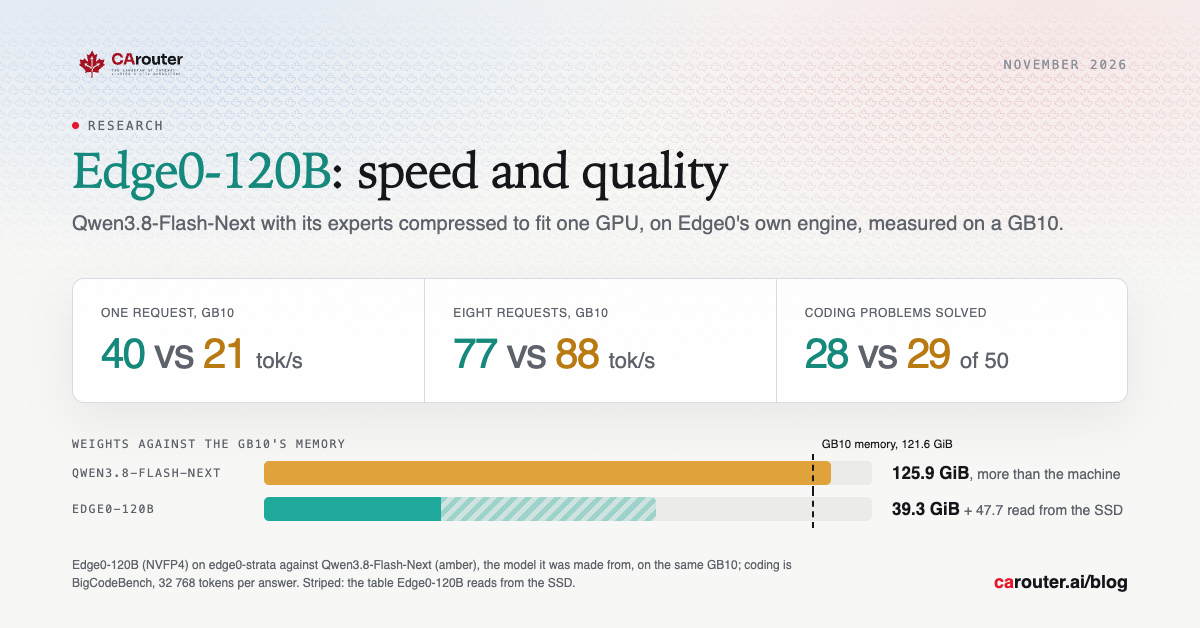
Edge0 released Edge0-120B on November 11. It is Qwen3.8-Flash-Next, the Qwen model that did not fit on our GB10 server in August, with its experts rebuilt at half their width and stored at 4 bits, so that the model fits on one GPU.
Edge0-120B runs only on Edge0's own inference engine. We built that engine on a rented GB10, the chip of the DGX Spark and of our own server, and measured the model's speed there and on an RTX PRO 6000 Blackwell, a workstation card with 96 GB. Then we ran our five quality tests.
The short version
- Memory. It fits. The GPU holds 39 GiB of weights, and a 48 GiB lookup table stays on the SSD. Qwen3.8-Flash-Next needed the whole machine.
- One request. 40 tokens a second on a GB10, against 21 for Qwen3.8-Flash-Next on the same chip, and 119 on an RTX PRO 6000.
- Many requests. Edge0's engine answers one request at a time unless it is given slots. With 8 slots it writes 77 tokens a second in total on a GB10, where Qwen3.8-Flash-Next wrote 88.
- Quality. It codes as well as Qwen3.8-Flash-Next, 28 problems of 50 against 29. On our other four tests it scores at or below Qwen3.8-27B, a smaller model that fits the same chip, and it writes 28% more tokens.
- Licence. Research and benchmarks are allowed. Running it as a commercial service needs a separate written licence from Edge0.
Experts at half width
Qwen3.8-Flash-Next is a mixture of experts: each of its 48 layers holds 512 small networks, and each token goes through 10 of them plus a shared one. The experts make up 121 billion of its parameters, and a lookup table of word sequences 51 billion more.
Edge0 kept the routing, the attention and the lookup table, and rebuilt every expert to work at a width of 1 280 instead of 2 560. A projection shared by a group of experts narrows each token before them and widens it after. The experts fall to 60 billion parameters, 31.6 GiB at 4 bits.
Edge0 also stores the layers around the experts at 8 bits, where every build of the original kept them at 16. Writing one token now reads about 7 GB from memory instead of 9.8, and most of the speed comes from there.
Edge0 says the model was trained at 4 bits from the start. It publishes no training recipe.
Speed on a GB10
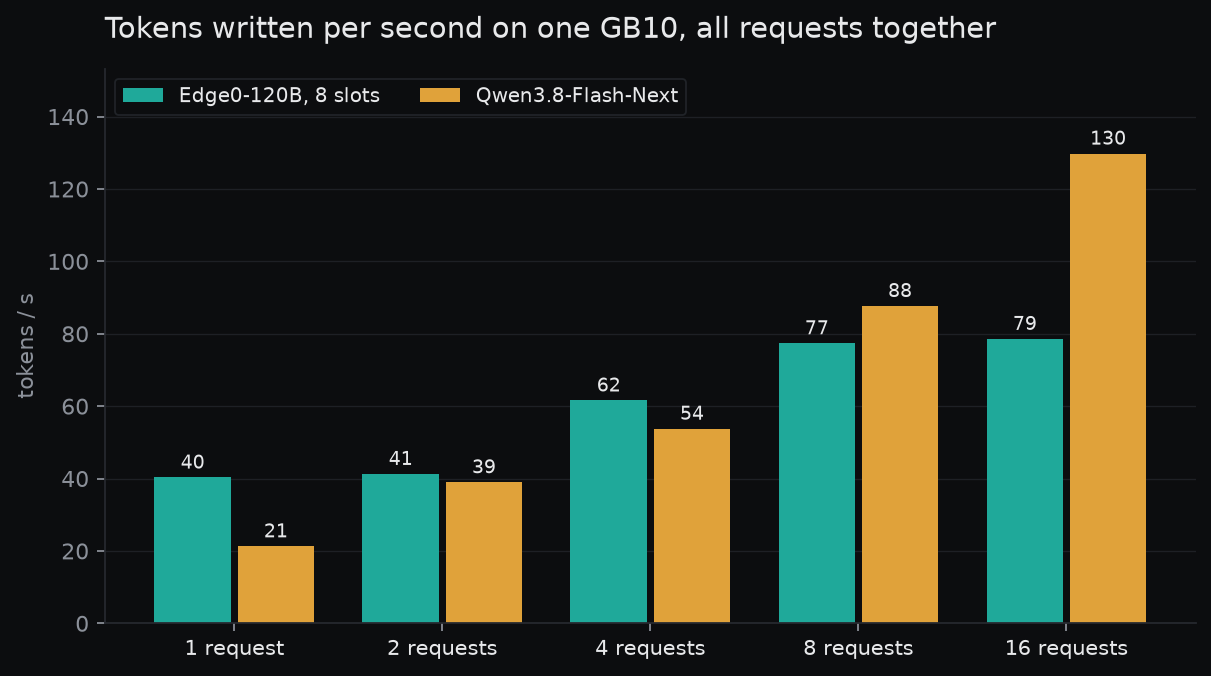
One request alone writes 40 tokens a second, the mean of three runs, and 39 with 4 000 tokens of context. Qwen3.8-Flash-Next wrote 21.3 on the same chip in August, on a patched version of vLLM that read its lookup table from the SSD.
Edge0 reports 45 tokens a second for chat and 69 for agent work on an RTX Spark N1X. Our probe asks for a long piece of code with reasoning on, and counts every token written for 40 seconds.
By default the engine serves one request at a time: with two at once, the second waits for the first to finish. The engine can also decode several requests together in slots, an option Edge0 leaves off. With 8 slots, the total reaches 62 tokens a second for 4 requests and 77 for 8, and a ninth request waits for a free slot.
With many requests the order turns. Qwen3.8-Flash-Next, on vLLM, wrote 88 tokens a second in total for 8 requests and 130 for 16, where Edge0-120B stops at 77 and 79. Edge0-120B is built for one user at a desk.
The engine reads a prompt at about 1 400 tokens a second, so a 12 000-token prompt waits 8 seconds for its first token. Qwen3.8-Flash-Next read 1 400 to 1 800 tokens a second on the same chip.
Memory leaves room. With one request the engine takes about 43 GiB of the GB10's 121.6 GiB, and about 58 GiB with 8 slots, while the lookup table is read from the SSD as needed. Qwen3.8-Flash-Next took the whole machine.
On an RTX PRO 6000, which holds every expert in its 96 GB, one request writes 119 tokens a second and 8 slots 229 in total, and a prompt is read at about 4 400 tokens a second. Edge0 reports 125 for chat on an RTX 5090 D.
Quality
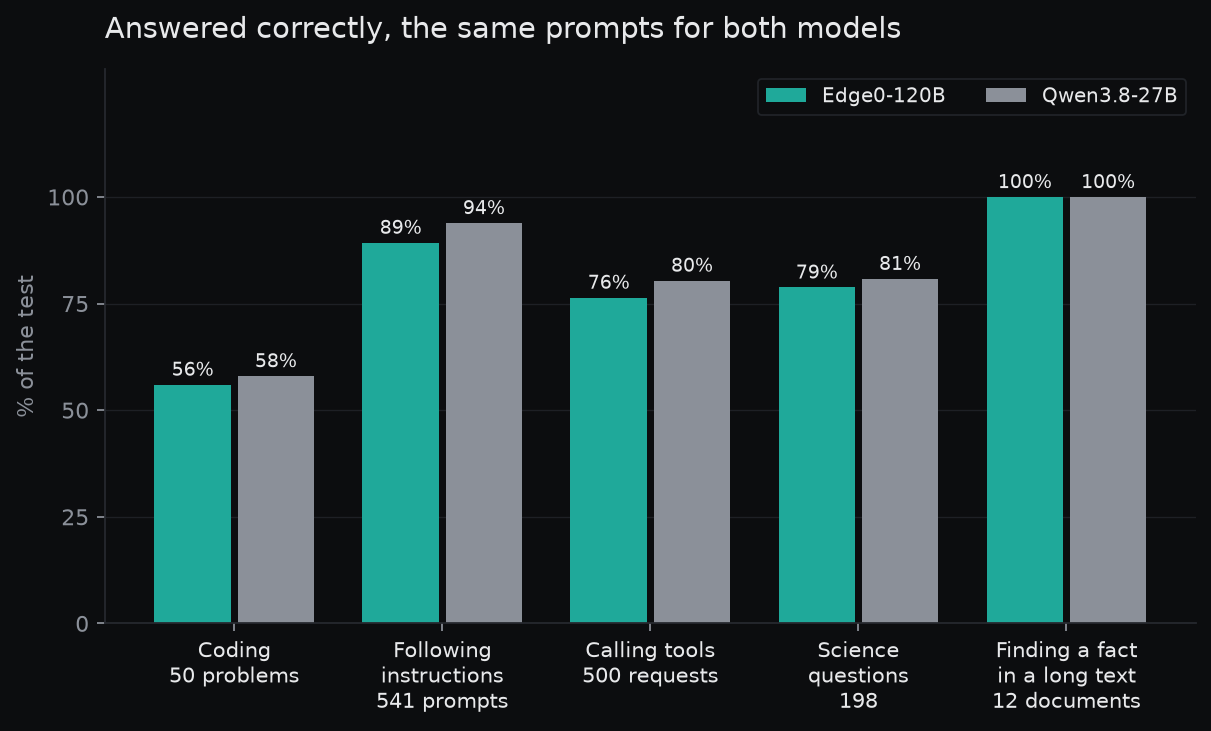
We ran our five tests with the same prompts as for every model we measure, and each answer could use up to 32 768 tokens, 8 192 for the long-text test. Qwen3.8-Flash-Next ran only the coding test, in August, so on all five we compare Edge0-120B with Qwen3.8-27B, a dense model Edge0 also compares itself with.
Science questions are close. On GPQA Diamond, Edge0-120B answered 156 of 198 correctly and Qwen3.8-27B 160, a gap within chance.
Edge0-120B reasons at length, 13 900 tokens per science question on average. The engine closed its reasoning at the 24 576-token mark on 71 questions, and 37 of those answers were right, against 119 of the 127 it finished on its own. Edge0 reports 87.4 on this test, with settings its card does not give, and a larger token limit is the likeliest place for that gap to close.
Instructions show the clearest gap. On IFEval's 541 prompts, Edge0-120B followed every instruction of 483 and Qwen3.8-27B of 508, a gap too wide for chance.
Tool calls trail too. On 500 BFCL requests, Edge0-120B made the right call 382 times and Qwen3.8-27B 402, a gap beyond chance. Half of it comes from requests where no tool fits: Edge0-120B called one anyway.
Coding is level with the original. On 50 BigCodeBench problems, Edge0-120B solved 28, Qwen3.8-Flash-Next 29 on our GB10 in August, and Qwen3.8-27B 29. Qwen3.8-Flash-Next ran out of tokens on 10 of them, and Edge0-120B on none.
All three models found a sentence hidden in documents of 16 000 to 100 000 tokens, 12 times out of 12.
What one answer costs in time
On a GB10, the time to a whole answer is the tokens written over the speed. A coding answer from Edge0-120B averages 15 350 tokens and takes 6 minutes 21 seconds, where Qwen3.8-Flash-Next wrote 16 751 at half the speed and took 13 minutes. A science answer takes 5 minutes 45 seconds on the GB10 and under 2 minutes on an RTX PRO 6000.
Across the five tests, Edge0-120B wrote 5.55 million tokens, reasoning included, against 4.33 million for Qwen3.8-27B.
How we measured
Edge0-120B is published as a set of files that only Edge0's engine reads: edge0-strata, a fork of the Strata engine. Our benchmark feature serves models with vLLM, so we built the engine ourselves from Edge0's repository, at its November 12 commit, and ran the tests by hand on rented machines.
We started the engine with the settings of Edge0's own launcher, including its speculative decoding: the model's own draft layer proposes 4 tokens at a time. Sampling is the engine's default for this model, temperature 1.0, top-p 0.95 and top-k 20, the values we used for Qwen3.8-27B. Reasoning ran at the default effort, the highest.
The engine closes the reasoning at three quarters of the token limit, so that an answer always has room. With our limit of 32 768 tokens, Edge0-120B reasons for at most 24 576. Qwen3.8-27B and Qwen3.8-Flash-Next ran on engines without that rule, where an answer still reasoning at the limit scores zero.
On the RTX PRO 6000, which holds every expert at once, the engine froze on its first token. Edge0's notes describe the same freeze on another chip and the switch that turns that path off; with it, everything ran.
Speed comes from one GB10 and one RTX PRO 6000, the model alone on each. The quality tests ran with 8 slots on the GB10 (tool calls, long documents) and on three RTX PRO 6000 cards (the rest), and a score does not depend on the card.
The speed probe keeps 1 to 16 requests running for 40 seconds after a 20-second warm-up, and counts every token written in that window.
The figures are also on our benchmarks page, beside every other model we measured. See the benchmarks.
What remains open
- A larger token limit. On science questions Edge0-120B reasoned past our budget more than a third of the time, and Edge0 reports 87.4 on GPQA Diamond under its own settings.
- Agentic work. Edge0 reports 75.3 on Terminal-Bench 2.1, which we did not run.
- Edge0-145B. Edge0 publishes a larger sibling, also built for one GPU.
- A commercial licence. Serving Edge0-120B on CArouter would need Edge0's written permission.