Pricing that makes sense
Our pricing policy for models we host ourselves: a market reference adjusted for sovereignty, explicit cost assumptions and room to invest while demand grows. Other providers keep their pricing.
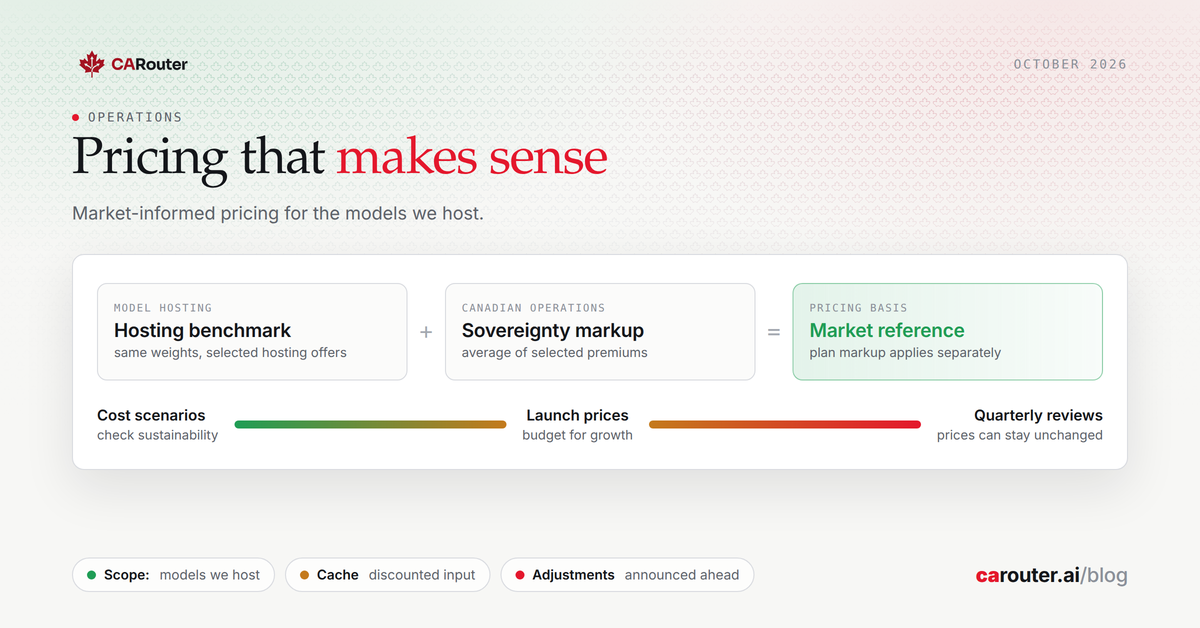
This policy applies only to models we host ourselves through CARouter Cloud. Models served by other providers keep their published rates, converted to Canadian dollars, plus your plan's markup. Their pricing is unchanged by this policy.
We want prices that are logical for the models available today and for those we add later. We use a market reference to position an offer, cost estimates to assess its sustainability, and explicit launch decisions while demand grows.
What we mean by market reference
The market reference benchmarks alternative hosting of the same model weights. Our default starts with the mean price of eligible OpenRouter offers, converted to Canadian dollars, then adds a 10% sovereignty markup for Canadian-owned, Canadian-served inference. The benchmark covers model hosting; our routing and platform services are priced separately.
We estimate that markup by giving equal weight to selected pricing observations from Google Cloud, OUTSCALE, Microsoft Azure and AWS: (5% + 20% + 0% + approximately 15%) / 4 = approximately 10%.
This is our selected-offer benchmark. The packages have different guarantees, and the average excludes taxes, separate support subscriptions and additional security services. Azure's zero refers to its base surcharge, not the total cost of a sovereign deployment. The AWS estimate comes from tecRacer's January 2026 calculator comparison with Frankfurt, after currency conversion; we have not independently refreshed it. We adopt 10% as an initial positioning assumption and review the selection quarterly.
These infrastructure and control-package prices do not establish equivalent certifications or an equivalent Canadian routing service. Selecting different packages would change the average: using a Google regulatory package at 20% would give approximately 13.75% instead. We use its regional data-and-support package as our starting assumption.
Comparisons account for context, performance, caching, availability and residency. When an alternative already provides comparable sovereignty, we use its rate without adding that premium again.
The sovereignty markup is part of the CARouter Cloud inference base rate. Your plan's markup applies separately for routing, billing and platform operations.
Where no comparable offer exists
We estimate a starting price from the capacity a model reserves and the work it performs: memory, measured throughput, hardware, hosting and electricity. We use a common contribution target, then check the result against alternative ways to perform the task.
A cost per token depends on how much capacity is used. Our initial reference assumption is 10% utilization. We also examine 5% and 20% scenarios at the same chosen prices. These are planning assumptions; actual costs per token depend on the workload and measured utilization.
Investing while demand grows
As a startup, we can choose a launch price below estimated sustainable serving costs. We record the reason, set a review date and budget the unrecovered capacity cost. A quiet machine does not automatically make your next request more expensive.
An expensive deployment can call for better batching, a smaller memory reservation or different hardware. We assess those options alongside pricing. The service must remain useful at the price customers pay.
What this changes for your bill
We price fresh input, cached input and output together. Reusing a cached prompt avoids repeated prompt processing, so confirmed cache hits receive a discount. Generating an answer still uses compute.
The effect depends on your workload. Repeated-context conversations and agents can benefit from the cache discount, while workloads that generate long answers with little caching can cost more. We check representative requests and existing usage before changing rates.
Example: Qwen3.6 35B A3B
In our October 1, 2026 snapshot, we convert the mean OpenRouter rates from USD to CAD at 1.4243, then apply the 10% sovereignty markup and round to four decimals. These illustrative rates are in CAD per million tokens, before the plan markup.
| Calculation step | Fresh input | Cached input | Generated output |
|---|---|---|---|
| Hosting benchmark in CAD | 0.2178 | 0.0943 | 1.5800 |
| Base rate after the 10% markup | 0.2396 | 0.1037 | 1.7380 |
For 12,000 prompt tokens and 100 output tokens, this gives CAD $0.003049 without caching, or approximately CAD $0.001554 when 11,000 prompt tokens are confirmed cached, before the plan markup and billing rounding.
We also check sustainability: at 10% utilization in our colocation scenario, estimated serving costs per million tokens are CAD $0.0804 for fresh input, $0.0031 for cached input and $1.4897 for output. These estimates exclude company overhead; any uncovered capacity cost at lower demand is part of our launch budget.
See the current rates in the documentation.
Quarterly reviews, announced changes
Every three months we review market references, serving costs, performance and demand. A review can leave prices unchanged. It does not automatically reprice your requests.
We announce increases to affected customers before they take effect, with an effective date and an estimate based on their usage. Decreases can take effect immediately. The documentation is generated from the catalog used for billing, so it remains the place to check the applicable rates.